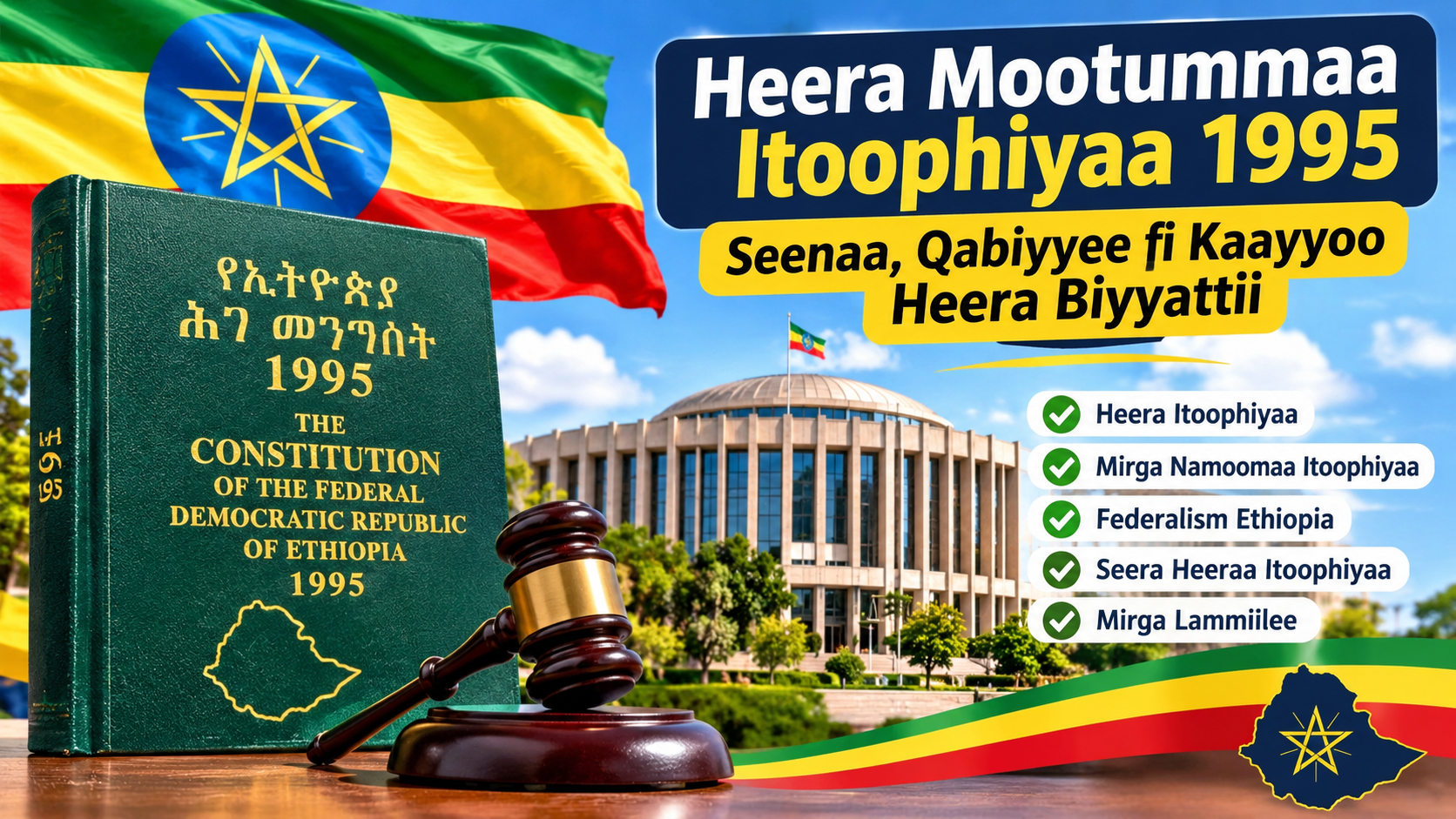

Heera Mootummaa Itoophiyaa 1995: Seenaa, Qabiyyee fi Kaayyoo Heera Biyyattii
Heera Itoophiyaa, mirga namoomaa, sirna federaalaa fi dirqamoota lammiilee Afaan Oromoo, English fi Amharic baradhaa.
Qabiyyee Barreeffamaa
1. Seensa 2. Seenaa Heera Itoophiyaa 3. Caasaa fi Boqonnaawwan Heeraa 4. Mirga Namoomaa 5. Federalism fi Aangoo Mootummaa 6. Heera fi Hojii Daldalaa 7. Dirqamoota Lammiilee 8. Heera fi Seera Idilee Walbira Qabuu 9. Faayidaa fi Qormaata 10. Gorsa Ogeessaa 11. Gaaffilee Yeroo Baay'ee Gaafataman 12. Xumura1. Heera Mootummaa Itoophiyaa 1995 Maali? Seensa Bal'aa
Heera Mootummaa Itoophiyaa 1995 seera bu'uuraa sirna mootummaa, mirga namoomaa, bilisummaa, aangoo mootummaa fi dirqamoota lammiilee ibsuudha. Heerri kun maqaa Ingiliffaan Constitution of the Federal Democratic Republic of Ethiopia jedhama.
Biyya tokko keessatti mootummaa eenyutu hooggana? Aangoon mootummaa akkamitti qoodama? Lammiileen mirga akkamii qabu? Hojjetaan mirga isaa akkamitti beeka? Abbaa daldalaa tokko seera hojii fi qabeenyaa isaa eessa irraa hubata? Gaaffileen kunneen hundi hubannoo seeraa barbaadu.
Kanaaf, Heera Itoophiyaa beekuun barattoota qofaaf osoo hin taane, abbootii daldalaa, hojjettoota, dhaabbilee, barsiisota, ogeessota seeraa fi namoota jireenya hawaasaa keessatti hirmaatan hundaaf barbaachisaa dha.
Heerri mootummaa seera idilee qofa miti. Inni seerota biroo ittiin madaalamu, aangoo mootummaa daangessu, akkasumas mirgoota bu'uuraa namootaa ibsuudha.
2. Seenaa Heera Mootummaa Itoophiyaa 1995
Seenaa Heera Itoophiyaa hubachuun jijjiirama sirna mootummaa biyyattii keessa darbe hubachuuf nu gargaara. Itoophiyaan yeroo adda addaatti heera mootummaa fi sirna bulchiinsaa garaagaraa hordofaa turte.
2.1 Heera bara 1931
Heerri bara 1931 yeroo mootummaa Hayile Sillaasee keessatti bahe. Heerri kun seera bu'uuraa mootummaa yeroo sanaa ta'ee tajaajile. Sirna mootummaa, aangoo mootii fi caasaa bulchiinsaa irratti qajeelfamoota kaa'e.
2.2 Heera bara 1955
Bara 1955 heerri mootummaa fooyya'aan bahe. Innis heera duraanii irratti jijjiirama fi bal'ina tokko tokko fide. Qaamolee mootummaa, aangoo fi dhimma bulchiinsaa irratti qajeelfamoota haaraa dabale.
2.3 Jijjiirama bara 1974 fi mootummaa Dargii
Bara 1974 jijjiiramni siyaasaa guddaan uumamee sirni mootummaa duraanii kufe. Bulchiinsi Dargii hundaa'e. Sirni mootummaa, imaammanni fi seerotni biyyattii jijjiirama keessa seenan.
2.4 Heera bara 1987
Bara 1987 heerri mootummaa haaraan ragga'e. Heerri kun yeroo mootummaa People's Democratic Republic of Ethiopia keessatti sirna mootummaa fi caasaa bulchiinsaa ibsuuf tajaajile.
2.5 Heera bara 1995
Heerri mootummaa yeroo ammaa bu'uura ta'e bara 1995 hojii irra oole. Labsii Lakkoofsa 1/1995 jalatti maxxanfame. Heerri kun sirna federaalaa, mirga sabootaa, mirga namoomaa, sirna dimokiraasii fi aangoo qaamolee mootummaa ibsa.
Guyyaan ragga'iinsaa fi guyyaan hojii irra oolmaa adda adda. Muddee 8, 1994 ragga'e; Hagayya 21, 1995 hojii irra seene.
3. Caasaa fi Boqonnaawwan Heera Mootummaa Itoophiyaa 1995
Heerri mootummaa kun boqonnaawwan 11 fi keewwatawwan 106 qaba. Boqonnaawwan kunneen qajeeltoowwan mootummaa, mirga namoomaa, caasaa federaalaa, aangoo qaamolee mootummaa fi adeemsa fooyya'iinsa Heeraa ni ibsu.
Boqonnaa I: Qajeeltoowwan Waliigalaa
Boqonnaan kun eenyummaa mootummaa, daangaa biyyattii, alaabaa, afaan mootummaa federaalaa, aangoo ummataa fi ol'aantummaa Heeraa irratti xiyyeeffata.
Boqonnaa II: Qajeeltoowwan Dimokiraasii
Aangoon mootummaa ummata irraa akka maddu, mootummaa fi lammiileen itti gaafatamummaa akkamii akka qaban, akkasumas hirmaannaan uummataa maal akka fakkaatu ibsa.
Boqonnaa III: Mirga Bu'uuraa fi Bilisummaa
Keewwata 13 hanga 44 keessatti mirgoota bu'uuraa fi bilisummaan namootaa ibsamaniiru. Isaan keessaa mirga jireenyaa, walqixxummaa, amantii, yaada ibsachuu, walga'ii, waldaa ijaaruu, qabeenyaa fi barnootaa ni argamu.
Boqonnaawwan IV fi V: Caasaa Mootummaa fi Qoodinsa Aangoo
Boqonnaawwan kunneen sirna federaalaa, mootummaa naannolee fi mootummaa federaalaa gidduutti aangoon akkamitti akka qoodamu ibsu.
Boqonnaawwan VI hanga X: Qaamolee Mootummaa
Boqonnaawwan kunneen qaamolee mootummaa akka Mana Maree Bakka Bu'oota Uummataa, Mana Maree Federeeshinii, Pirezidaantii, qaama raawwachiiftuu fi mana murtii irratti qajeelfamoota kaa'u.
Boqonnaa XI: Dhimmoota Waliigalaa
Boqonnaan dhumaa dhimmoota waliigalaa, qajeeltoowwan mirgoota hawaasummaa, dirqamoota mootummaa fi lammiilee, akkasumas fooyya'iinsa Heeraa ilaallata.
4. Mirga Namoomaa Itoophiyaa: Mirga Lammiilee Heera Keessatti
Mirgoonni bu'uuraa Heera Mootummaa Itoophiyaa keessatti iddoo guddaa qabu. Keewwata 13 jalatti qaamoleen mootummaa mirgoota bu'uuraa kabajuu, eeguu fi hojiirra oolchuu akka qaban qajeelfamni kaa'ameera.
4.1 Mirga jireenyaa
Keewwanni 15 mirga jireenyaa nama hundaaf beekamtii kenna. Mirgi jireenyaa mirgoota bu'uuraa keessaa isa tokko dha.
4.2 Mirga walqixxummaa
Keewwanni 25 namoonni hundi seera duratti walqixa ta'uu isaanii ibsa. Loogiin sababa saalaa, afaanii, amantii, ilaalcha siyaasaa ykn haala hawaasummaa irratti hundaa'e dhorkamaa dha.
4.3 Mirga yaada ibsachuu
Keewwanni 29 bilisummaa yaada ibsachuu fi odeeffannoo argachuu irratti tumaa qaba. Mirgi kun barnoota, qorannoo, miidiyaa fi marii hawaasaaf barbaachisaa dha.
4.4 Mirga amantii
Keewwanni 27 mirga amantii qabaachuu, filachuu, jijjiirachuu fi amantii ofii karaa seera qabeessa ta'een hordofuu ibsa.
4.5 Mirga walga'ii fi waldaa
Keewwanni 30 walga'ii nagaa fi mormii nagaa irratti mirga kenna. Keewwanni 31 ammoo mirga waldaa ijaaruu ilaallata.
4.6 Mirga sochii
Keewwanni 32 sochii bilisaa, biyya keessa socho'uu fi haala Heera keessatti ibsameen biyya keessaa bahuu fi seenuu ilaallata.
4.7 Mirga qabeenyaa
Keewwanni 40 mirga qabeenyaa dhuunfaa irratti tumaa qaba. Haa ta'u malee, dhimma lafa irratti heerri sirna addaa kaa'a: lafti fi qabeenyi uumamaa mootummaa fi ummata Itoophiyaa ta'uu ibsa.
4.8 Mirga dubartootaa fi daa'immanii
Keewwanni 35 mirga dubartootaa fi walqixxummaa saalaa irratti xiyyeeffata. Keewwanni 36 ammoo mirga daa'immanii, eegumsa, guddina, barnootaa fi kabaja isaanii ibsa.
4.9 Mirga barnootaa fi misoomaa
Keewwanni 41 mirgoota hawaasummaa fi dinagdee irratti qajeeltoowwan kaa'a. Keewwanni 43 hirmaannaa ummataa misooma keessatti qabu ilaallata.
5. Federalism Ethiopia: Sirna Federaalaa Itoophiyaa
Federalism jechuun sirna mootummaa keessatti aangoon mootummaa giddugaleessaa fi mootummaa naannolee gidduutti heeraan qoodamuudha. Itoophiyaan sirna mootummaa federaalaa hordofti.
5.1 Mirga ofiin of bulchuu
Keewwanni 39 mirga sabootaa, sab-lammootaa fi ummattootaa ibsa. Mirgoota kana keessatti afaan, aadaa, eenyummaa, ofiin of bulchuu fi haala Heera keessatti tumameen murtee ofii ofiin murteessuu ni argamu.
5.2 Aangoo mootummaa federaalaa
- Dhimmoota ittisaa biyyaalessaa.
- Hariiroo alaa.
- Dhimmoota maallaqaa federaalaa.
- Daldala alaa fi dhimmoota biyya guutuu ilaallatan.
- Aangoo Heeraan mootummaa federaalaaf kenname.
5.3 Aangoo mootummaa naannolee
- Bulchiinsa naannoo.
- Dhimmoota misooma naannoo.
- Seerota naannoo aangoo isaanii keessatti tumuu.
- Tajaajila hawaasummaa fi hojiiwwan heeraan kenname.
Qoodinsi aangoo kun keewwata 50 hanga 52 keessatti bal'inaan ibsameera. Dhimma tokko irratti qaamni aangoo qabu eenyu akka ta'e mirkaneessuuf Heera fi seerota raawwachiiftuu ilaaluun barbaachisaa dha.
6. Heera Mootummaa Itoophiyaa 1995 fi Hojii Daldalaa
Abbaan daldalaa tokko yeroo hojii isaa jalqabu, seera galmee dhaabbataa, gibiraa, hojjettootaa, qabeenyaa, waliigaltee fi eegumsa maamiltootaa hubachuun isa barbaachisa. Heerri mootummaa bu'uura seeraa biyya keessatti hojii daldalaa gaggeessuuf barbaachisu keessaa tokko dha; garuu seera daldalaa fi gibiraa bakka hin bu'u.
6.1 Mirga hojii fi qabeenyaa
Heerri mirga qabeenyaa dhuunfaa fi mirgoota hojii irratti qajeeltoowwan kaa'a. Abbootiin daldalaa mirga isaanii hubachuun seerota daldalaa, hojii fi invastimantii waliin walitti hidhuu qabu.
6.2 Waliigaltee fi itti gaafatamummaa
Dhaabbileen daldalaa waliigaltee maamiltootaa, dhiyeessitootaa fi hojjettootaa yeroo qopheessan seera hojii irra jiru kabajuu qabu. Waliigalteen ifa ta'e rakkoo seeraa fi waldhabdee hir'isa.
6.3 Gibira fi seera dhaabbataa
Heerri qajeeltoowwan waliigalaa kaa'a; gibira kaffaluu, galmee daldalaa, VAT, hayyama hojii fi gabaasa herregaa irratti seerota addaa ilaaluun barbaachisaa dha.
7. Dirqamoota Lammiilee Itoophiyaa
Heerri mirga qofa osoo hin taane dirqamoota lammiilees ibsa. Keewwata 12 keessatti iftoomina fi itti gaafatamummaa mootummaa irratti qajeelfamni jira; keewwata 92 keessatti dhimma naannoo eeguu irratti tumaan jira. Dirqamoota lammiilee keessaa:
- Heera mootummaa fi seerota biyya kabajuu.
- Mirga namoota biroo kabajuu.
- Qabeenya uummataa eeguu.
- Naannoo kunuunsuu.
- Gibira seeraan murtaa'e kaffaluu.
- Nageenya fi tasgabbii hawaasaa deeggaruu.
- Dhimmoota uummataa keessatti karaa seera qabeessa ta'een hirmaachuu.
8. Garaagarummaa Heera Mootummaa fi Seera Idilee
| Heera Mootummaa | Seera Idilee |
|---|---|
| Seera bu'uuraa biyyattii dha. | Seera dhimma murtaa'e qajeelchu dha. |
| Aangoo mootummaa ni qooda. | Hojii fi adeemsa addaa ni ibsa. |
| Mirgoota bu'uuraa ni tumsa. | Mirgootaa fi dirqamoota bal'inaan ni qajeelcha. |
| Ol'aantummaa seeraa qaba. | Heera waliin wal simuu qaba. |
| Fooyya'iinsaaf adeemsa addaa qaba. | Adeemsa seera tumuu idileetiin fooyya'uu danda'a. |
Ol'aantummaa Heeraa
Keewwata 9 jalatti Heerri seera olaanaa biyyattii ta'uu ibsameera. Seerri ykn gochi mootummaa Heera faallessu Heera waliin wal simuu hin danda'u.
Fooyya'iinsa Heeraa
Keewwata 104 fi 105 adeemsa fooyya'iinsa Heeraa ibsu. Fooyya'iinsi tokko hundi adeemsa tokko hin qabu. Mirgoota boqonnaa sadaffaa ilaallatan irratti ulaagaan raggaasuu addaa fi cimaa ta'e jira.
9. Faayidaa fi Qormaata Heera Mootummaa Itoophiyaa
Faayidaa
- Mirgoota bu'uuraa namootaa beekamtii fi eegumsa seeraa kennuu.
- Aangoo mootummaa qooduu fi daangessuu.
- Sirna federaalaa fi ofiin of bulchuu ibsuu.
- Qajeeltoowwan dimokiraasii fi hirmaannaa uummataa kaa'uu.
- Seerota biroo ittiin madaaluuf bu'uura ta'uu.
Qormaata hojii irra oolmaa
- Lammiileen hundi Heera fi mirga isaanii gahumsaan beekuu dhabuu.
- Hubannoo seeraa fi tajaajila gorsaa seeraa argachuun bakka tokko tokkootti ulfaachuu.
- Seera tumuu fi hojii irra oolchuu gidduutti hanqinni uumamuu.
- Waldhabdee hiika Heeraa fi aangoo mootummaa irratti mariin fi adeemsi seeraa barbaachisuu.
Qormaata kana hubachuun yaada siyaasaa tokko fudhachuu jechuu miti. Ragaa, seera, murtii mana murtii fi muuxannoo hawaasaa adda baasanii qorachuun barbaachisaa dha.
10. Gorsa Ogeessaa: Heera Itoophiyaa Akkamitti Sirriitti Qoranna?
- Heera guutuu dubbisi: Cuunfaa qofa irratti hin hirkatiin.
- Keewwata ilaali: Yaada tokko yeroo dubbistu lakkoofsa keewwataa isaa barreessi.
- Madda seeraa mirkaneessi: Federal Negarit Gazeta fi galmeewwan mootummaa fayyadami.
- Fooyya'iinsa seeraa hordofi: Seeronni raawwachiiftuu fi labsiiwwan yeroo yeroon jijjiiramuu danda'u.
- Gorsa ogeessaa gaafadhu: Dhimmi kee falmii, waliigaltee ykn invastimantii taanaan ogeessa seeraa mariisisi.
- Mirga fi dirqama walitti hidhi: Mirga ofii hubachuun mirga nama biraas kabajuuf gargaara.
11. Gaaffilee Yeroo Baay'ee Gaafataman (FAQ)
1. Heerri Mootummaa Itoophiyaa 1995 yoom ragga'e?
Muddee 8, 1994 bakka bu'oota filatamaniin ragga'e; Hagayya 21, 1995 guutummaatti hojii irra oole.
2. Heerri Itoophiyaa boqonnaa fi keewwata meeqa qaba?
Boqonnaawwan 11 fi keewwatawwan 106 qaba.
3. Heerri Itoophiyaa seera olaanaa dhaa?
Eeyyee. Keewwata 9 jalatti Heerri seera olaanaa biyyattii ta'uu ibsameera.
4. Mirga namoomaa Itoophiyaa keessatti eessa argama?
Boqonnaa sadaffaa, keewwata 13 hanga 44 keessatti mirgoonni bu'uuraa fi bilisummaan ibsamaniiru.
5. Keewwanni 39 maal ibsa?
Mirga sabootaa, sab-lammootaa fi ummattootaa, mirga ofiin of bulchuu fi mirga murtee ofii ofiin murteessuu ibsa.
6. Heera Itoophiyaa eenyutu hiika?
Mana Maree Federeeshinii gahee hiika Heeraa irratti qaba. Adeemsa kana keessatti Mana Maree Qorannoo Dhimma Heeraa gorsa ni kenna.
7. Heera mootummaa jijjiiruun ni danda'amaa?
Eeyyee. Garuu adeemsa addaa keewwata 104 fi 105 keessatti ibsame hordofuu qaba.
8. Heerri mootummaa abbootii daldalaaf maal faayidaa qaba?
Bu'uura mirga qabeenyaa, mirga hojii, walqixxummaa fi aangoo mootummaa hubachuuf gargaara. Garuu seerota daldalaa fi gibiraa bakka hin bu'u.
12. Xumura: Heera Mootummaa Itoophiyaa 1995 Beekuun Maaliif Barbaachisa?
Heera Mootummaa Itoophiyaa 1995 seera bu'uuraa sirna mootummaa, mirga namoomaa, dimokiraasii, federalism fi aangoo qaamolee mootummaa ibsuudha. Seenaa isaa, boqonnaawwan isaa, mirga lammiilee fi dirqamoota uummataa hubachuun beekumsa lammummaa cimsuuf gargaara.
Barataa, barsiisaa, hojjetaa, abbaa daldalaa ykn qorataa yoo taate, Heera beekuun murtii sirrii kennuu fi mirga kee hubachuuf bu'uura dha.
Amma yaada kee qoodadhu: Keewwata Heera Itoophiyaa keessaa isa kam irratti odeeffannoo dabalataa argachuu barbaadda? Yaada kee comment keessatti barreessi; barreeffama kana namoota seera fi lammummaa barachuu barbaadaniif qoodi.
Table of Contents
1. Introduction 2. Historical Background 3. Structure and Chapters 4. Fundamental Rights 5. Federalism in Ethiopia 6. Constitution and Business 7. Citizens' Responsibilities 8. Constitution vs Ordinary Laws 9. Benefits and Challenges 10. Practical Expert Tips 11. Frequently Asked Questions 12. Conclusion1. What Is the Ethiopian Constitution of 1995?
The Ethiopian Constitution of 1995 is the foundational legal framework of the Federal Democratic Republic of Ethiopia. It establishes the structure of government, defines the distribution of public powers, recognizes fundamental rights and freedoms, and sets out important responsibilities of government institutions and citizens.
Its official name is the Constitution of the Federal Democratic Republic of Ethiopia. It is commonly referred to as the FDRE Constitution or Ethiopian Constitution 1995.
Why should an ordinary citizen, student, employee or business owner care about constitutional law? Because the Constitution influences how public authority is organized, how rights are recognized, how institutions operate and how government decisions are assessed against the country's highest law.
For business owners, constitutional knowledge is useful background when considering property rights, equality, employment principles and the relationship between federal and regional institutions. However, the Constitution does not replace detailed commercial, tax, labour or investment legislation.
2. History of the Ethiopian Constitution
Ethiopia's constitutional history reflects major changes in its political and institutional development. Understanding this background helps readers distinguish the 1995 constitutional framework from earlier systems of government.
2.1 The 1931 Constitution
The 1931 Constitution was introduced during the reign of Emperor Haile Selassie. It provided a formal constitutional framework for the imperial state and described aspects of governmental authority and administration.
2.2 The 1955 Revised Constitution
A revised Constitution was introduced in 1955. It modified and expanded elements of the earlier framework, including provisions relating to government institutions and public authority.
2.3 The 1974 Political Transition
The 1974 revolution brought an end to the imperial system and established the Derg government. The country's political institutions and legal framework underwent major changes during this period.
2.4 The 1987 Constitution
A new Constitution was adopted in 1987 under the People's Democratic Republic of Ethiopia. It reflected the political and institutional structure of that period.
2.5 The 1995 Constitution
The current federal constitutional framework was adopted by elected representatives on 8 December 1994 and entered into force on 21 August 1995. Proclamation No. 1/1995 formally brought it into effect.
The distinction between adoption and commencement is important: the adoption date was in 1994, while the Constitution became fully effective in 1995.
3. Structure of the Ethiopian Constitution of 1995
The Constitution contains 11 chapters and 106 articles. These provisions address foundational principles, rights and freedoms, federal arrangements, public institutions, government powers and constitutional amendment procedures.
Chapter I: General Provisions
This chapter addresses the name of the state, territory, sovereignty, official federal working language, national flag and foundational constitutional principles.
Chapter II: Fundamental Principles
These provisions address democratic principles, popular sovereignty, government accountability and the relationship between public authority and the people.
Chapter III: Fundamental Rights and Freedoms
Articles 13–44 address fundamental rights and freedoms. They include rights relating to life, equality, liberty, religion, expression, assembly, association, property and social and economic interests.
Chapters IV and V: State Structure and Division of Powers
These provisions establish the federal structure and address the relationship between the federal government and regional states.
Chapters VI–X: Government Institutions
The Constitution sets out the roles of federal legislative institutions, the House of Federation, the President, the executive and the judiciary.
Chapter XI: Miscellaneous Provisions
The final chapter includes additional constitutional matters, responsibilities, policy principles and procedures for constitutional amendment.
4. Human Rights in Ethiopia: Fundamental Rights Under the Constitution
Fundamental rights are an essential part of the Ethiopian Constitution. Article 13 provides an important framework for interpreting and respecting the rights contained in Chapter Three.
4.1 Right to Life
Article 15 recognizes the right to life. This is one of the central rights protected by the Constitution.
4.2 Equality Before the Law
Article 25 establishes the principle of equality before the law and equal protection without discrimination on prohibited grounds.
4.3 Freedom of Expression
Article 29 recognizes freedom of thought, opinion and expression, including the right to seek, receive and impart information.
4.4 Freedom of Religion
Article 27 protects freedom of religion, belief and conscience, subject to the constitutional framework.
4.5 Assembly and Association
Article 30 addresses the right of assembly and demonstration. Article 31 concerns freedom of association.
4.6 Freedom of Movement
Article 32 addresses freedom of movement and related rights within the constitutional framework.
4.7 Property Rights
Article 40 addresses the right to property. It is important to distinguish private property rights from the Constitution's special treatment of land and natural resources, which are vested in the state and the peoples of Ethiopia.
4.8 Rights of Women and Children
Article 35 addresses women's rights and equality. Article 36 provides constitutional protections concerning children, including their welfare and development.
4.9 Education and Development
Articles 41 and 43 address economic, social and development-related principles and rights.
5. Federalism in Ethiopia: Understanding the Federal System
Federalism is a system in which public powers are constitutionally distributed between a central government and regional or constituent governments. Ethiopia's Constitution establishes a federal arrangement.
5.1 Self-Determination and Article 39
Article 39 addresses the rights of Nations, Nationalities and Peoples, including self-government, language and cultural rights, and the right to self-determination under the constitutional provisions.
5.2 Federal Government Powers
- National defence matters.
- Foreign relations.
- Federal monetary matters.
- Foreign trade and other nationally assigned responsibilities.
- Other powers allocated to the federal government by the Constitution.
5.3 Regional State Powers
- Regional administration.
- Regional development matters.
- Legislation within constitutionally assigned powers.
- Public services and responsibilities allocated to regional states.
Articles 50–52 are particularly important when studying the structure of government and the division of powers. The precise allocation of authority should be checked against the Constitution and applicable legislation.
6. The Ethiopian Constitution of 1995 and Business Owners
Entrepreneurs, ecommerce operators, companies and small business owners need to understand the legal environment in which they operate. Constitutional principles provide an important foundation, but commercial activities are also regulated by detailed laws and administrative requirements.
6.1 Property and Economic Activity
Article 40 addresses property rights, while other constitutional provisions address economic and social interests. Business owners should understand the distinction between private property and the constitutional land ownership framework.
6.2 Contracts and Business Responsibilities
Businesses should use clear written agreements with customers, employees, suppliers and service providers. Agreements should comply with applicable laws and explain the responsibilities of each party.
6.3 Tax and Business Registration
The Constitution is not a substitute for tax legislation, business registration requirements, licensing rules or VAT regulations. Entrepreneurs should consult the relevant laws and competent government institutions.
7. Responsibilities of Ethiopian Citizens
Constitutional rights exist alongside legal and civic responsibilities. Important responsibilities include:
- Respecting the Constitution and applicable laws.
- Respecting the rights of other people.
- Protecting public property.
- Contributing to environmental protection.
- Paying taxes lawfully imposed.
- Supporting peace and public order through lawful conduct.
- Participating in public affairs through lawful channels.
8. Constitution vs Ordinary Laws: Key Differences
| Constitution | Ordinary Legislation |
|---|---|
| Provides the country's foundational legal framework. | Regulates particular subjects and activities. |
| Allocates governmental powers. | Sets out detailed procedures and obligations. |
| Recognizes fundamental rights. | Provides specific rules for implementing legal rights. |
| Has the highest legal authority. | Must be consistent with the Constitution. |
| Has special amendment procedures. | Generally follows ordinary legislative procedures. |
Constitutional Supremacy
Article 9 establishes the supremacy of the Constitution. Any law, customary practice or decision of a government organ that contravenes the Constitution cannot be treated as consistent with the constitutional framework.
Constitutional Amendment
Articles 104 and 105 provide the procedures for initiating and approving constitutional amendments. Different constitutional provisions are subject to different approval requirements. Amendments affecting Chapter Three rights have special procedures.
9. Benefits and Challenges of the Constitutional Framework
Potential Benefits
- Recognizes fundamental rights and freedoms.
- Defines the distribution of government powers.
- Provides a legal foundation for federalism.
- Sets out principles of democratic participation.
- Provides a standard against which other laws can be assessed.
Implementation Challenges
- Limited constitutional awareness among some members of the public.
- Unequal access to legal information and legal services.
- Challenges in translating constitutional principles into consistent practice.
- Disagreements about constitutional interpretation and institutional powers.
These issues should be assessed through evidence, legal texts, court decisions and documented institutional practice rather than unsupported generalizations.
10. Expert Tips: How to Research Ethiopian Constitutional Law
- Read the primary text: Do not rely only on summaries or social media posts.
- Check article numbers: Verify every constitutional claim against the relevant article.
- Use official legal sources: Consult the Federal Negarit Gazeta and government legal databases.
- Check current legislation: Laws and administrative rules may change over time.
- Seek professional advice: Consult a qualified lawyer for individual disputes, contracts and investments.
- Separate rights from responsibilities: A sound understanding of constitutional law includes both.
11. Frequently Asked Questions
1. When was the Ethiopian Constitution of 1995 adopted?
It was ratified on 8 December 1994 and entered into full force on 21 August 1995.
2. How many chapters and articles does it contain?
It contains 11 chapters and 106 articles.
3. Is the Constitution the supreme law of Ethiopia?
Yes. Article 9 establishes its status as the supreme law of the country.
4. Where are fundamental rights addressed?
Chapter Three, Articles 13–44, addresses fundamental rights and freedoms.
5. What does Article 39 address?
It addresses the rights of Nations, Nationalities and Peoples, including self-determination and self-government.
6. Which institution has a role in constitutional interpretation?
The House of the Federation has the constitutional role in interpreting the Constitution, with the Council of Constitutional Inquiry providing recommendations.
7. Can the Ethiopian Constitution be amended?
Yes. Articles 104 and 105 set out special amendment procedures.
8. Why should business owners understand constitutional law?
It helps them understand foundational principles relating to equality, property, government powers and economic rights, while detailed business rules must be studied separately.
12. Conclusion: Why the Ethiopian Constitution of 1995 Matters
The Ethiopian Constitution of 1995 provides the foundational framework for the country's federal government, fundamental rights, democratic principles and distribution of public powers.
Understanding its history, structure, rights and responsibilities is valuable for students, teachers, workers, entrepreneurs and citizens. Constitutional knowledge helps people identify the relevant legal framework and understand where to find authoritative information.
Join the discussion: Which constitutional article would you like to understand in more detail? Share your thoughts in the comments and share this educational guide with others.
የጽሑፉ ዝርዝር
1. መግቢያ 2. የሕገ መንግሥቱ ታሪክ 3. የሕገ መንግሥቱ አወቃቀር 4. የሰብዓዊ መብቶች 5. ፌዴራሊዝም 6. ሕገ መንግሥቱና ንግድ 7. የዜጎች ግዴታዎች 8. ሕገ መንግሥትና መደበኛ ሕጎች 9. ጥቅሞችና ተግዳሮቶች 10. የባለሙያ ምክሮች 11. ተደጋጋሚ ጥያቄዎች 12. መደምደሚያ1. የኢትዮጵያ 1995 ዓ.ም. ሕገ መንግሥት ምንድን ነው?
የኢትዮጵያ 1995 ዓ.ም. ሕገ መንግሥት የኢትዮጵያ ፌዴራላዊ ዴሞክራሲያዊ ሪፐብሊክ መሠረታዊ ሕግ ነው። የመንግሥትን አወቃቀር፣ የሥልጣን ክፍፍልን፣ የዜጎችን መብቶችና ነፃነቶች እንዲሁም የመንግሥትና የዜጎችን ኃላፊነቶች ይደነግጋል።
የሕገ መንግሥቱን መሠረታዊ ሐሳቦች መረዳት ለተማሪዎች፣ ለመምህራን፣ ለሠራተኞች፣ ለነጋዴዎችና ለሁሉም ዜጎች ጠቃሚ ነው።
ሕገ መንግሥቱ የመንግሥት ሥልጣን እንዴት እንደሚደራጅ፣ መብቶች እንዴት እንደሚጠበቁና ሌሎች ሕጎች ከመሠረታዊ ሕጉ ጋር እንዴት መጣጣም እንዳለባቸው ይገልጻል።
2. የኢትዮጵያ ሕገ መንግሥት ታሪክ
የኢትዮጵያን የሕገ መንግሥት ታሪክ መረዳት የአገሪቱን የፖለቲካና የመንግሥት አወቃቀር ለመረዳት ይረዳል።
2.1 የ1931 ሕገ መንግሥት
የ1931 ሕገ መንግሥት በአፄ ኃይለ ሥላሴ ዘመን የወጣ ሲሆን የንጉሣዊውን መንግሥት የሕግ መሠረት ለመወሰን አገልግሏል።
2.2 የ1955 ሕገ መንግሥት
በ1955 የቀድሞውን ሕገ መንግሥት የሚያሻሽል አዲስ የሕገ መንግሥት ሰነድ ወጥቷል።
2.3 የ1974 የፖለቲካ ለውጥ
በ1974 የፖለቲካ ለውጥ ተከስቶ የንጉሣዊው ሥርዓት ተወግዶ የደርግ መንግሥት ተቋቋመ። የአገሪቱ የመንግሥትና የሕግ ሥርዓቶች ተለወጡ።
2.4 የ1987 ሕገ መንግሥት
በ1987 የኢትዮጵያ ሕዝባዊ ዴሞክራሲያዊ ሪፐብሊክ የሚባለውን ሥርዓት የሚያቋቁም ሕገ መንግሥት ጸድቋል።
2.5 የ1995 ሕገ መንግሥት
የአሁኑ የፌዴራል ሕገ መንግሥት በታኅሣሥ 8 ቀን 1994 ዓ.ም. ጸድቆ በነሐሴ 21 ቀን 1995 ዓ.ም. በአዋጅ ቁጥር 1/1995 ሥራ ላይ ውሏል።
3. የኢትዮጵያ ሕገ መንግሥት አወቃቀር
ሕገ መንግሥቱ 11 ምዕራፎችና 106 አንቀጾች አሉት። እነዚህም የመንግሥትን መሠረታዊ መርሆዎች፣ የሰብዓዊ መብቶችን፣ የፌዴራል ሥርዓቱንና የመንግሥት ተቋማትን ይዳስሳሉ።
የመጀመሪያ ምዕራፍ፡ አጠቃላይ ድንጋጌዎች
የአገሪቱን ስም፣ የግዛት ወሰን፣ ሉዓላዊነትና መሠረታዊ መርሆዎች ይገልጻል።
ሁለተኛ ምዕራፍ፡ መሠረታዊ የዴሞክራሲ መርሆዎች
የሕዝብ ሉዓላዊነትን፣ የመንግሥት ተጠያቂነትንና የሕዝብ ተሳትፎን ይመለከታል።
ሦስተኛ ምዕራፍ፡ መሠረታዊ መብቶችና ነፃነቶች
ከአንቀጽ 13 እስከ 44 ድረስ የሰው ልጅ መብቶችና ነፃነቶች ተደንግገዋል።
አራተኛና አምስተኛ ምዕራፎች፡ የመንግሥት አወቃቀርና የሥልጣን ክፍፍል
በፌዴራል መንግሥትና በክልሎች መካከል ያለውን የሥልጣን ግንኙነት ይወስናሉ።
ስድስተኛ እስከ አሥረኛ ምዕራፎች፡ የመንግሥት ተቋማት
የሕዝብ ተወካዮች ምክር ቤት፣ የፌዴሬሽን ምክር ቤት፣ ፕሬዚዳንት፣ አስፈጻሚ አካልና የዳኝነት አካል ሥልጣንና ሚና ይወስናሉ።
አሥራ አንደኛ ምዕራፍ፡ ልዩ ልዩ ድንጋጌዎች
ተጨማሪ አጠቃላይ ጉዳዮችንና የሕገ መንግሥት ማሻሻያ ሂደትን ይመለከታል።
4. በኢትዮጵያ ሕገ መንግሥት የተጠበቁ መሠረታዊ መብቶች
የሰብዓዊ መብቶች በሕገ መንግሥቱ ውስጥ ወሳኝ ቦታ አላቸው። አንቀጽ 13 የመሠረታዊ መብቶችን አከባበርና ጥበቃ የሚመለከት መርህ ይዟል።
4.1 የሕይወት መብት
አንቀጽ 15 የሰው ልጅ የመኖር መብትን ይጠብቃል።
4.2 በሕግ ፊት እኩልነት
አንቀጽ 25 ሁሉም ሰዎች በሕግ ፊት እኩል መሆናቸውን ይደነግጋል።
4.3 የአስተያየት ነፃነት
አንቀጽ 29 የአስተያየትና የመግለጽ ነፃነትን ይመለከታል።
4.4 የሃይማኖት ነፃነት
አንቀጽ 27 የሃይማኖትና የእምነት ነፃነትን ይጠብቃል።
4.5 የሰላማዊ ስብሰባና የመደራጀት መብት
አንቀጽ 30 የሰላማዊ ስብሰባን፣ አንቀጽ 31 ደግሞ የመደራጀት መብትን ይመለከታሉ።
4.6 የንብረት መብት
አንቀጽ 40 የግል ንብረትን ይመለከታል። ሆኖም መሬትና የተፈጥሮ ሀብቶች ላይ ሕገ መንግሥቱ የተለየ የባለቤትነት ሥርዓት ደንግጓል።
4.7 የሴቶችና የሕፃናት መብቶች
አንቀጽ 35 የሴቶችን መብቶች፣ አንቀጽ 36 ደግሞ የሕፃናትን መብቶች ይመለከታሉ።
4.8 የትምህርትና የልማት ጉዳዮች
አንቀጽ 41 ማህበራዊና ኢኮኖሚያዊ መብቶችን፣ አንቀጽ 43 ደግሞ በልማት የመሳተፍ መብትን ይመለከታሉ።
5. በኢትዮጵያ ያለው የፌዴራል ሥርዓት
ፌዴራሊዝም ማለት በማዕከላዊ መንግሥትና በክልሎች መካከል ሥልጣን በሕገ መንግሥት የሚከፋፈልበት የመንግሥት ሥርዓት ነው።
5.1 አንቀጽ 39 እና የራስን ዕድል የመወሰን መብት
አንቀጽ 39 የብሔር፣ የብሔረሰብና የሕዝቦችን መብቶች፣ የራስን የማስተዳደር መብትና በሕገ መንግሥቱ የተደነገጉ የራስን ዕድል የመወሰን መብቶች ይመለከታል።
5.2 የፌዴራል መንግሥት ሥልጣን
- የብሔራዊ መከላከያ ጉዳዮች።
- የውጭ ግንኙነት።
- የፌዴራል የገንዘብ ጉዳዮች።
- የውጭ ንግድና ሌሎች በሕገ መንግሥቱ የተመደቡ ሥልጣኖች።
5.3 የክልሎች ሥልጣን
- የክልል አስተዳደር።
- የክልል ልማት ጉዳዮች።
- በተሰጣቸው ሥልጣን ውስጥ ሕግ ማውጣት።
- የሕዝብ አገልግሎቶችና ሌሎች ተግባራት።
6. የኢትዮጵያ ሕገ መንግሥትና የንግድ ሥራ
ነጋዴዎችና ሥራ ፈጣሪዎች በሚሠሩበት ሕጋዊ ሁኔታ ላይ መሠረታዊ ግንዛቤ ሊኖራቸው ይገባል። ሕገ መንግሥቱ ለንግድ ሥራ አንዳንድ መሠረታዊ መርሆዎችን ይሰጣል፤ ሆኖም የንግድ፣ የግብርና የሥራ ሕጎችን አይተካም።
6.1 የንብረትና የኢኮኖሚ መብቶች
አንቀጽ 40 የንብረት መብትን ይመለከታል። ነጋዴዎች በግል ንብረትና በመሬት ላይ በሕገ መንግሥቱ የተደነገገውን ልዩነት ማወቅ አለባቸው።
6.2 ውልና የንግድ ኃላፊነት
ከደንበኞች፣ ከአቅራቢዎችና ከሠራተኞች ጋር ግልጽ የሆኑ ውሎችን ማድረግ የንግድ አደጋን ለመቀነስ ይረዳል።
6.3 ግብርና የንግድ ምዝገባ
የንግድ ፈቃድ፣ የግብር ክፍያ፣ VAT እና ሌሎች ግዴታዎች በተለያዩ ሕጎችና ደንቦች ይመራሉ። ስለዚህ የሚመለከታቸውን ሕጎች መመርመር ያስፈልጋል።
7. የኢትዮጵያ ዜጎች ኃላፊነቶች
ሕገ መንግሥቱ መብቶችን ብቻ ሳይሆን የዜጎችንም ኃላፊነቶች ያካትታል። ከእነዚህም መካከል፦
- ሕገ መንግሥቱንና ሕጎችን ማክበር።
- የሌሎችን መብት ማክበር።
- የሕዝብ ንብረትን መጠበቅ።
- አካባቢን መንከባከብ።
- በሕግ የተወሰነ ግብር መክፈል።
- ሰላምንና ሕጋዊ ሥርዓትን መደገፍ።
- በሕጋዊ መንገድ በሕዝባዊ ጉዳዮች መሳተፍ።
8. በሕገ መንግሥትና በመደበኛ ሕጎች መካከል ያለው ልዩነት
| ሕገ መንግሥት | መደበኛ ሕጎች |
|---|---|
| የአገሪቱ መሠረታዊ ሕግ ነው። | የተወሰኑ ጉዳዮችን ይመራሉ። |
| የመንግሥትን ሥልጣን ይከፋፍላል። | ዝርዝር የአሠራር ሕጎችን ያስቀምጣሉ። |
| መሠረታዊ መብቶችን ይደነግጋል። | የተወሰኑ መብቶችንና ግዴታዎችን ይገልጻሉ። |
| ከፍተኛ የሕግ ሥልጣን አለው። | ከሕገ መንግሥቱ ጋር መጣጣም አለባቸው። |
| ልዩ የማሻሻያ ሂደት አለው። | በመደበኛ የሕግ አወጣጥ ሂደት ሊሻሻሉ ይችላሉ። |
የሕገ መንግሥት የበላይነት
አንቀጽ 9 ሕገ መንግሥቱ የአገሪቱ የበላይ ሕግ መሆኑን ይደነግጋል።
የሕገ መንግሥት ማሻሻያ
አንቀጽ 104 እና 105 የሕገ መንግሥት ማሻሻያ ሂደቶችን ይገልጻሉ። ሁሉም ድንጋጌዎች በአንድ ዓይነት ሂደት አይሻሻሉም።
9. የሕገ መንግሥቱ ጥቅሞችና ተግዳሮቶች
ጥቅሞች
- የመሠረታዊ መብቶችን የሕግ ጥበቃ ያቀርባል።
- የመንግሥትን ሥልጣን ይወስናል።
- ለፌዴራል ሥርዓት መሠረት ይሆናል።
- የዴሞክራሲና የሕዝብ ተሳትፎ መርሆዎችን ያስቀምጣል።
- ሌሎች ሕጎችን ለመገምገም መሠረት ይሆናል።
የትግበራ ተግዳሮቶች
- የሕገ መንግሥት ግንዛቤ እጥረት።
- የሕግ መረጃና የሕግ አገልግሎት ተደራሽነት ችግሮች።
- መርሆዎችን ወደ ተግባር የመቀየር ተግዳሮቶች።
- በሕገ መንግሥት ትርጓሜና በተቋማት ሥልጣን ላይ አለመግባባቶች።
10. የባለሙያ ምክሮች፡ ሕገ መንግሥቱን እንዴት ማጥናት ይቻላል?
- ዋናውን የሕገ መንግሥት ሰነድ ያንብቡ።
- የሚጠቅሱትን አንቀጽ ቁጥር ያረጋግጡ።
- ይፋዊ የሕግ ምንጮችን ይጠቀሙ።
- አዳዲስ ሕጎችንና ማሻሻያዎችን ይከታተሉ።
- ለግል የሕግ ጉዳይ ብቃት ያለውን የሕግ ባለሙያ ያማክሩ።
- መብትንና ኃላፊነትን አብረው ይረዱ።
11. ተደጋጋሚ ጥያቄዎች
1. የኢትዮጵያ ሕገ መንግሥት መቼ ጸደቀ?
በታኅሣሥ 8 ቀን 1994 ዓ.ም. ጸድቆ በነሐሴ 21 ቀን 1995 ዓ.ም. ሥራ ላይ ውሏል።
2. ስንት ምዕራፎችና አንቀጾች አሉት?
11 ምዕራፎችና 106 አንቀጾች አሉት።
3. ሕገ መንግሥቱ የአገሪቱ የበላይ ሕግ ነው?
አዎ። አንቀጽ 9 ሕገ መንግሥቱ የበላይ ሕግ መሆኑን ይደነግጋል።
4. የሰብዓዊ መብቶች የት ተደንግገዋል?
በሦስተኛው ምዕራፍ፣ ከአንቀጽ 13 እስከ 44 ድረስ ተደንግገዋል።
5. አንቀጽ 39 ምንን ይመለከታል?
የብሔር፣ የብሔረሰብና የሕዝቦችን መብቶችና የራስን ዕድል የመወሰን መብትን ይመለከታል።
6. ሕገ መንግሥቱን ማሻሻል ይቻላል?
አዎ። በአንቀጽ 104 እና 105 የተደነገጉትን ልዩ ሂደቶች መከተል ያስፈልጋል።
7. ሕገ መንግሥቱ ለነጋዴዎች ምን ጥቅም አለው?
ስለ ንብረት፣ እኩልነት፣ የመንግሥት ሥልጣንና የኢኮኖሚ መርሆዎች መሠረታዊ ግንዛቤ ይሰጣል።
12. መደምደሚያ፡ የ1995 ዓ.ም. ሕገ መንግሥትን ማወቅ ለምን አስፈለገ?
የኢትዮጵያ 1995 ዓ.ም. ሕገ መንግሥት የመንግሥት አወቃቀርን፣ የሰብዓዊ መብቶችን፣ የፌዴራል ሥርዓትንና የዴሞክራሲ መርሆዎችን የሚያስቀምጥ መሠረታዊ ሕግ ነው።
ታሪኩን፣ ይዘቱን፣ መብቶችንና ኃላፊነቶችን መረዳት ለተማሪዎች፣ ለመምህራን፣ ለሠራተኞች፣ ለነጋዴዎችና ለሁሉም ዜጎች ጠቃሚ ነው።
የእርስዎን አስተያየት ያጋሩ: ስለ የትኛው የሕገ መንግሥት አንቀጽ ተጨማሪ ማብራሪያ ማግኘት ይፈልጋሉ? በአስተያየት ይጻፉ።
📚 Authoritative References / Maddoota Amanamoo
Related Articles / Barreeffamoota Walqabatan
Learn More. Understand Your Rights.
Share this educational guide and help others understand the Ethiopian Constitution.
Explore More Articles